Quality Control Checkpoints in Perfume Production
Quality control in perfume production is a sequence of checkpoints, each of which produces a record and a decision. The scent itself is only one of them. Fill weight, component conformity, leakage, labelling and documentation all gate a release, and a batch can be held on any of them. The practical question for a brand is not whether a factory has a quality system, but which checkpoints exist, what triggers a hold, and who is allowed to override one.
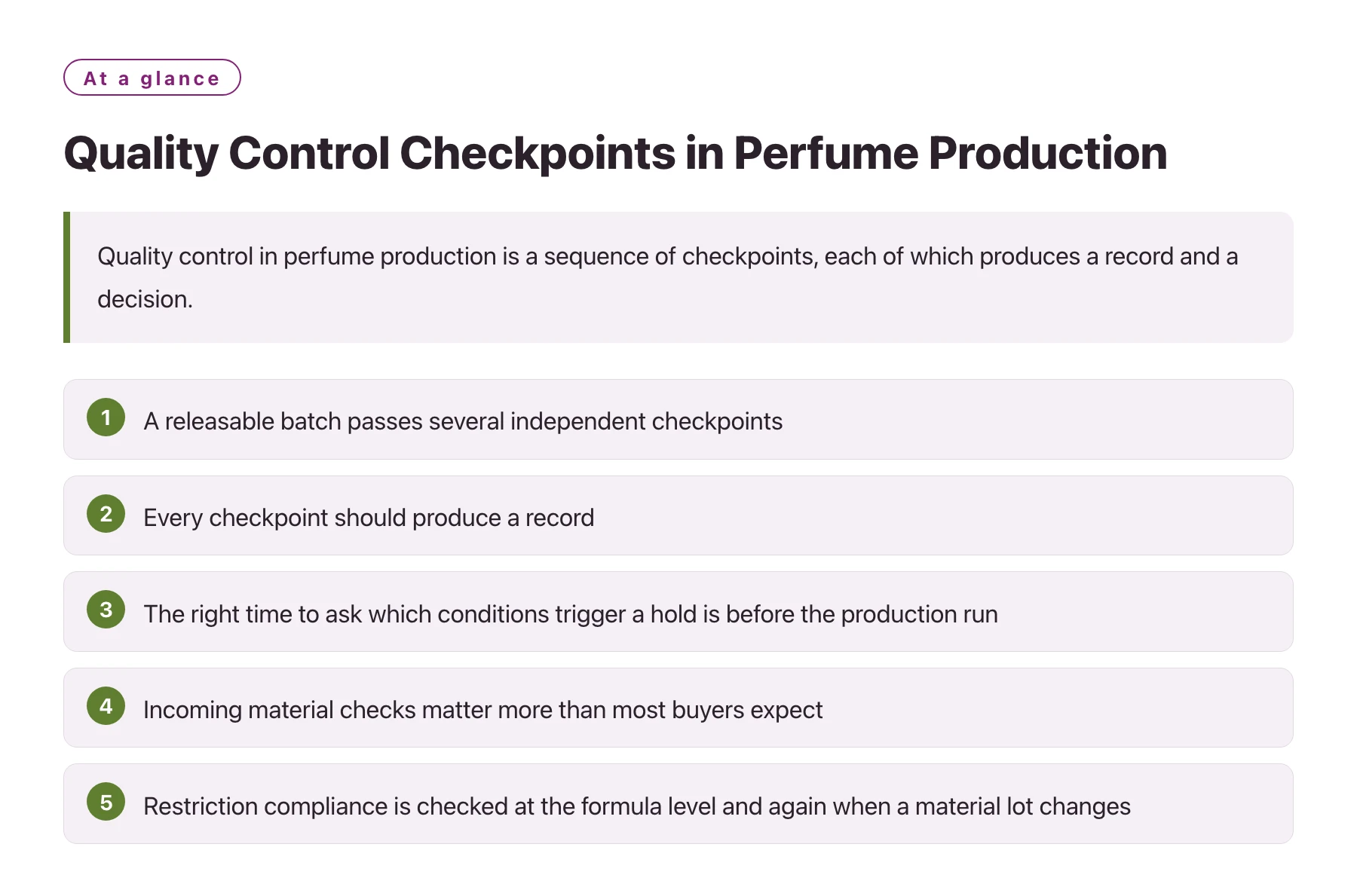
Key takeawaysA releasable batch passes several independent checkpoints, and the fragrance is only one of them. · Every checkpoint should produce a record; a checkpoint with no paper trail cannot be audited or repeated. · The right time to ask which conditions trigger a hold is before the production run, not after a delivery is questioned. · Incoming material checks matter more than most buyers expect, because a different lot of the same material can shift how a formula performs [1]. · Restriction compliance is checked at the formula level and again when a material lot changes, since the limit applies to the finished product as sold [2].
Buyers tend to think about quality control as a final inspection: the batch arrives, someone smells it, and the delivery is accepted or rejected. In a factory that runs a real quality system, the final check is the last of a series, and most of the decisions that determine whether the order is acceptable were made earlier.
That matters for a brand because the earlier a problem is caught, the cheaper it is to fix. A fill weight drifting outside tolerance is a line adjustment in week one and a pallet of unusable stock in week six.
This is written for a brand or a procurement team that wants to ask specific questions about quality rather than general ones.
The checkpoints, what they measure and what they leave behind
| Checkpoint | What is measured | Record produced | What commonly goes wrong |
|---|---|---|---|
| Incoming materials | Identity of the lot, supplier documentation, condition on arrival [1] | Goods-in record linked to the material lot | Lots accepted on paperwork alone, with no check of identity |
| Compounding | Weights, order of addition, mixing parameters, batch identification | Compounding record signed at each step | Record reconstructed after the batch instead of during it |
| Bulk check | Appearance, odour against the reference, and the specified physical parameters | Bulk release note | Odour checked informally by whoever is nearby |
| Filling | Fill weight or volume within tolerance, checked at intervals across the run | Fill record with the sampling interval | Only the start of the run is checked |
| Assembly and components | Cap, pump and carton conformity against the approved standard | Component check record | Approved by eye against a screen rather than a physical standard |
| Label and coding | Batch code, artwork version, correct market variant | Label verification record | The right artwork, the wrong market version |
| Final release | Complete documentation package and retained reference sample | Release decision with a signature | Released before the documentation is complete |
Read the third column as a list of things you can ask to see. A factory with a functioning system will hand over several of these records without preparation, which is the fastest way to distinguish a quality system from a quality claim.
Where the scent is checked, and where it is not enough
The fragrance is verified against a retained reference sample at the bulk stage, and that comparison is the point of keeping a reference at all. It is a comparison, not a preference test, which is why the reference has to be sealed, labelled and stored on both sides rather than remembered.
What many buyers do not realise is that this check sits after the point where the materials were already accepted. If a different lot of a raw material behaves slightly differently, the bulk check is where it becomes visible, and by then the batch exists. That is why incoming material control is not a formality.
Restriction compliance is checked on the formula and revisited whenever a material lot or a supplier changes, because the limit applies to what is actually in the finished product [2]. A factory that treats the restriction check as a one-off document from two years ago is describing a formula, not a batch.
Which conditions trigger a hold
Ask this question in writing before the run. A useful answer names specific conditions: a fill weight outside the stated tolerance, a bulk odour that falls outside the agreed characters, a component that does not match the approved standard, or an incomplete document pack. A vague answer usually means the decision is made case by case by whoever is present.
The second half of the question is who can override a hold and how the override is recorded. Every factory has an override path; the difference between a good and a poor one is whether the override is written down and signed.
What a paper quality system looks like
It tends to have certificates on the wall and few records at the line. Documents exist for the audits and are produced on request rather than as a by-product of the work. The tell is the timing: a real record is available immediately because it was written as the batch was made.
Signs that a checkpoint is only on paper
- Records are stored centrally and are never seen at the line where the work happens.
- Fill weight is recorded as a single value rather than a series across the run.
- Odour is checked by whoever is available, with no reference sample in the room.
- Component conformity is checked against a screen image rather than a physical approved standard.
- Documentation is assembled after the batch and back-dated to match the production date.
- The batch record contains no deviations, and nobody can explain what would count as one.
- Release signatures come from a single person for every department.
How to build quality questions into the first order
The first production run is the cheapest place to test a quality system, because the order is small and the cost of a hold is low. Ask for the complete record pack with the delivery, compare the fill record against the specification, and check the batch code on the carton against the code in the release note.
Third-party testing is a useful addition rather than a substitute for a factory's own checks. Independent laboratories publish what each test covers and how samples should be submitted, and a test commissioned by the brand gives an outside reading on the same batch [3]. Where the brand is the responsible person for the product, having that independent report in the file is worth more than a supplier's assurance.
If you want to see how a manufacturer describes its own checkpoints before you ask, Visit the website and look for whether the process is explained at all. A page that describes stages and responsibilities is easier to question than a page that only lists capabilities, and the questions it raises are the ones worth bringing to the first call.
Ask the same quality questions of every supplier and keep the answers in the same format. A manufacturer that publishes their OEM/ODM manufacturing services gives you a fixed description to test against, which makes the comparison with a second supplier considerably faster and less dependent on how well each one presents.
Put the release criteria in the specification
A specification that names only the fill weight leaves the odour comparison informal. Write the characters that must be present and the ones that must not, and reference the retained sample. Then a release decision becomes a comparison against a written standard rather than a matter of opinion.
For a premium positioning, the same logic applies with tighter tolerances. quality control in luxury fragrance production covers how those expectations change the checkpoint list when the product is sold at a higher price point.
Check the testing at the same time
Quality records prove that the production process ran as specified; they do not prove that the product meets an external standard. safety testing in perfume manufacturing covers the tests that sit alongside production control, and the two belong in the same conversation with a supplier. Ask who commissions each test and who pays for it, because that determines who holds the result.
If the brand asks for one thing from a quality system on a first order, it should be the complete record pack with the delivery. Reading it takes an hour, and it answers the questions that a site visit and a certificate list cannot.
Sources
- Cosmetics & Toiletries —— A technical magazine for cosmetic formulators, covering ingredients, formulation science and testing methods.
- IFRA Standards Library (International Fragrance Association) —— The IFRA Standards Library lists the restrictions the fragrance industry applies to individual fragrance ingredients, based on safety assessments; it is the reference point for compliant fragrance formulation.
- SGS: Cosmetics, Personal Care & Household Testing —— Testing, inspection and certification services for cosmetics and personal care, including microbiological, stability and safety testing aligned with cosmetics GMP.
Frequently asked questions
How much of quality control is about the fragrance itself?
Less than buyers expect. The scent is checked against the reference at the bulk stage, while incoming materials, compounding, filling, components, labelling and documentation account for most of the checkpoints that can hold a batch.
What is a retained reference sample for?
It turns an odour judgement into a comparison. The approved batch is sealed and labelled, one copy stays with the factory and one with the brand, and every later bulk delivery is measured against it rather than against memory.
Should I pay for independent testing if the factory already tests?
It depends on the market and on who signs for the product. Independent testing gives the brand its own reading on the batch and a document it holds, which is useful when the brand is the responsible person on the label.
What should happen if a batch fails a checkpoint?
It should be held, the reason recorded, and the decision to release, rework or reject signed by someone with the authority to make it. Ask before the run which conditions trigger a hold and how an override is documented.
How can I check a factory's quality system without a visit?
Ask for a batch record for a recent run and read it for evidence of the work: measurements taken across the run, deviations with signatures, and a release decision. Records produced immediately are a much stronger signal than certificates.
Do smaller orders get the same quality checks?
They should. The checkpoint list belongs to the product and the specification, not to the order size. If a factory describes a shortened process for small runs, ask which checkpoints are dropped.